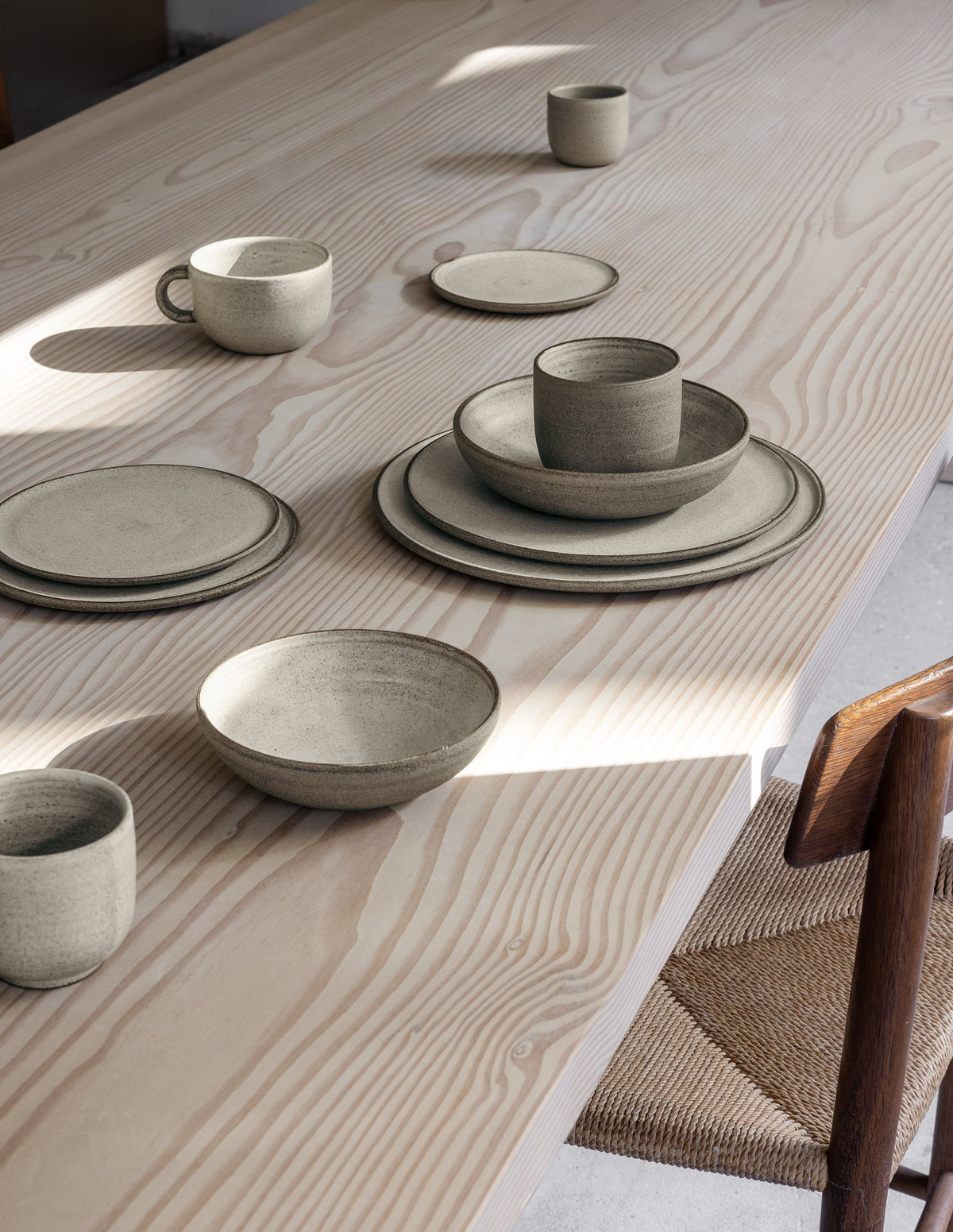
What Is Stoneware? How It Differs from Earthenware and Porcelain
Tableware shops often just say "ceramics", but earthenware, stoneware and porcelain are three different things. The difference is not in how they look but in how hot they were fired and whether the finished body still absorbs water.
This guide sets out how the three differ and why stoneware suits tableware you use every day. We use Ancher as the example, and only give figures we can find in the maker's documents or published standards.
The difference is water absorption
When clay is fired, some of its components melt into a glassy phase that fills the pores. This is called vitrification. The hotter the firing and the more complete the vitrification, the less water the finished body absorbs. That is why water absorption is the usual way to tell the three apart. Taking the definitions used by the US International Trade Commission as an example:
| Earthenware | Absorbs more than 3% water. Fired at lower temperatures, often below 1100°C. The body is porous. |
| Stoneware | Absorbs no more than 3% water. Fired at around 1100 to 1300°C. Dense, solid and durable. |
| Porcelain | Absorbs no more than 0.5% water. Fired hotter still. The densest body; thin areas let light through. |
Stoneware sits between the two: denser and tougher than earthenware, while keeping the texture and warmth of the clay, and neither as white nor as thin as porcelain.
What low absorption means in use
- ◆ Less staining and fewer lingering smells: with few pores, sauces and odours have little to seep into.
- ◆ More durable: a dense body is stronger and suits daily use and washing.
- ◆ Dishwasher and microwave: whether a piece can go in depends on the maker's documents. Ancher's declaration of conformity states that the whole range is dishwasher, microwave and steamer safe.
Ancher's stoneware
Ancher Studio is a ceramics brand founded in Copenhagen in 2023 by the designer Elisabeth Snejbjerg. The pieces are made in collaboration between a Danish studio and a family-run pottery workshop in Poland. According to the maker's declaration of conformity, the whole range is stoneware fired at 1250°C.
Each collection has its own clay and glaze:
- ◆ Everyday: a semi-matte, scratch-resistant glaze, in colours such as cream and olive.
- ◆ Studio: brown clay with a matte white glaze or a deep blue glaze inside.
- ◆ Bistro: beige clay, a shiny transparent glaze, thrown by hand.
- ◆ No. 16: speckled clay with a white glaze.


Why no two pieces are alike
Ancher pieces are thrown and glazed by hand. On the wheel, each piece ends up with slightly different curves and thickness; in the kiln, the glaze moves in the heat and pools differently at rims and edges. These variations are not flaws but the mark of handwork, and they are what makes a set of the same pieces look alive on the table.


Stoneware's limits
- ◆ Heavier and thicker than porcelain: it has real weight in the hand. If you prefer light, thin tableware, handle it before you decide.
- ◆ The glaze dislikes sharp knives: cutting hard on the plate with a sharp steak knife can leave marks. Try not to cut directly on the plate.
- ◆ Not recommended for the oven: Ancher's documents do not list oven use, so we do not recommend putting it in the oven.
- ◆ Avoid sudden temperature changes: do not pour boiling soup into a piece straight from the fridge; let it come to room temperature first.
Common questions
Is stoneware the same as ceramics? "Ceramics" covers earthenware, stoneware and porcelain. Stoneware is one kind of ceramic, between earthenware and porcelain.
Can stoneware go in the dishwasher? It depends on each maker's documents. Ancher's declaration of conformity states that the whole range is dishwasher, microwave and steamer safe.
Will handmade tableware leak or absorb water? Stoneware absorbs very little, and the surface is glazed, so it will not leak in everyday use. Where the base is left unglazed and the clay shows, dry it after washing.
To hold the pieces and see the glazes in person, book a visit to our studio in Anping, Tainan, or ask us on LINE.